Showing posts with label history. Show all posts

Wednesday, March 13, 2013

Competition


     In the United States, our culture fosters the expectation that growth, economic and otherwise, is constant. In the past twenty or thirty years, however, we have seen less innovation than during any other period of time in the last century. What is the common denominator? What is different now?
     Last Friday, I was listening to Fareed Zakaria give a speech about the infinitely repeating cycle of rise, peak, decline, crisis in civilizations and how it relates to actual threats to our society and economy. What struck me was how he identified that one of the greatest issues that our nation currently faces is the lack of international competition. He stated that competition is the principal force that drives the growth of a nation. Without it, we have little incentive to change and innovate. This is when I realized that the Cold War may have been the best thing that happened to the United States in the past sixty years.
     Like most people, when I thought about the Cold War, the first things that came to mind were the widespread paranoia of nuclear proliferation and the wonderfully cheesy black-and-white anti-communist propaganda videos.
     What I found is more important is the innovation that was spurred by our competition with the Soviet Union. The end of the Second World War was the starting block for a race between nations that was to last over forty years. The two nations were in fierce competition. The fear of potential confrontation fueled rapid positive changes in nearly all aspects of American society and government.
     The Marshall Plan of 1948 was a massive change in US diplomacy. The funding of the reconstruction of crumbled European countries was intended to prevent Europeans from falling into poverty and turning to communism. This brilliant foreign aid packaged accomplished the stabilization of democracies throughout Western Europe and the growth of the global economy by providing a solid foundation for various markets.
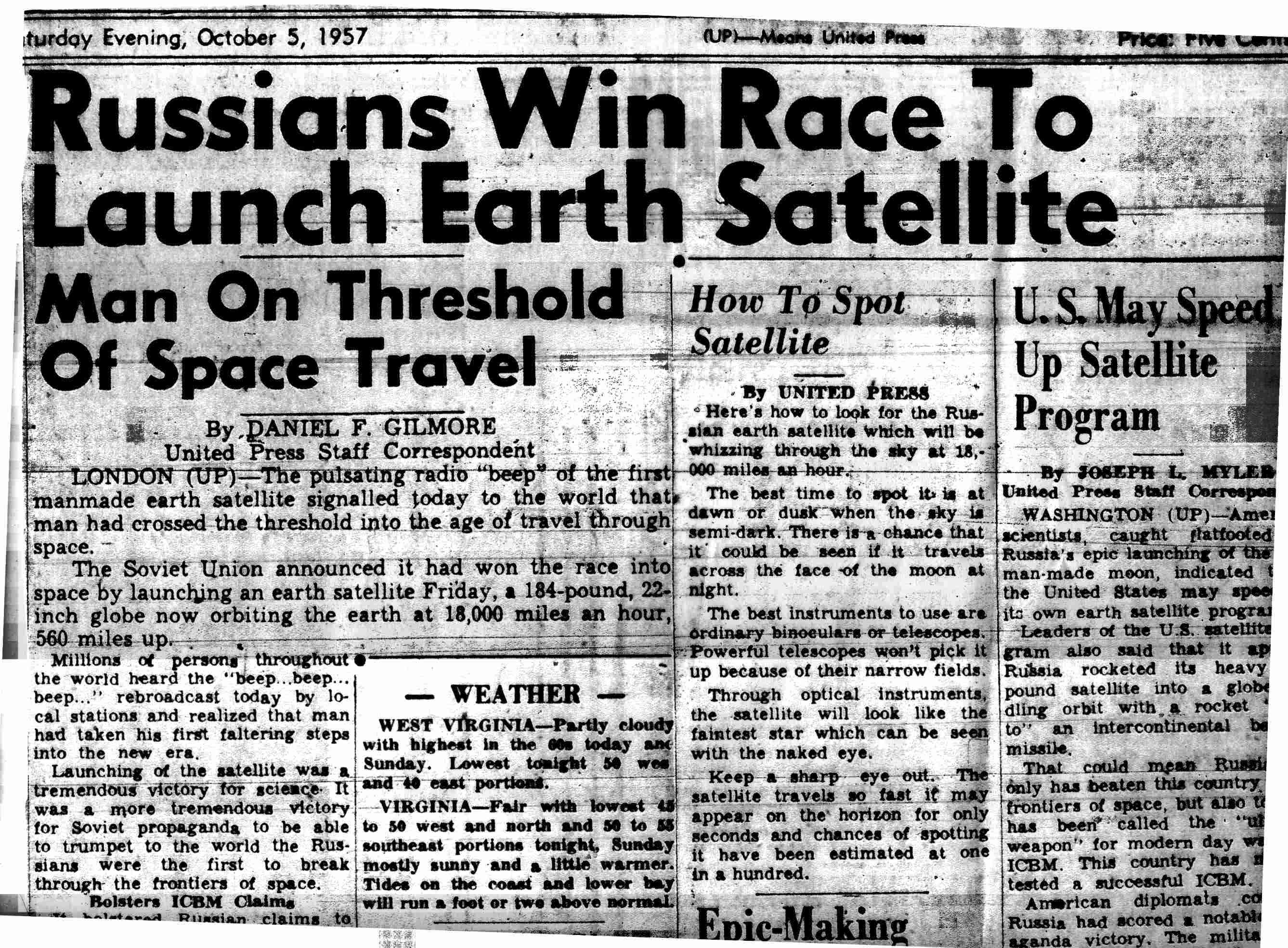
     The Soviets' successful launch of Sputnik was a shock to the American people. It gave the United States a major incentive to fund improvements in math, science, and physical education. The satellite also motivated the federal government to create the National Aeronautics and Space Administration, which was to subsequently launch successful missions to the Moon.
     Communist uprisings around the world pushed the government to rethink its military strategies, focusing more on small-scale operations and less on more traditional large battles.
     Without competition, our nation will maintain a slow rate of innovation and creativity. It is safe to say that, without the Cold War, the United States would be much worse off.

Sunday, March 3, 2013

The History of India and Pakistan's Not-So-Friendly Relationship

-->
           

The India-Pakistan rivalry is a conflict as old as the two nations themselves—dating back to the era of British colonialism. In 1947, the British Empire, exhausted and suffering economic stresses from the aftermath of World War II, retreated from South Asia with the decision to partition the territories into states. The Indian National Congress, supporter of Indian-nationalism, and the Muslim League, supporter of Muslim-nationalism, were instructed to establish a constitutional framework for post-colonial India by the full withdrawal of British forces in 1947.
When an agreement was not reached by the deadline, British Viceroy Louis Mountbat-ten devised a plan that would establish territory based on population: areas with a Muslim-majority would be Pakistan and areas with Hindu-majority would be India. The 565 princely states in South Asia were also involved in the partition, and the rulers were given the power to decide which country they wanted to join.
The plan sparked immediate outcry. Violence and bloodshed erupted between Hindus, Sikhs, and Muslims, resulting in 500,000 to 1 million casualties. Conflict also centered around Kashmir and Hyderabad, a Hindu-led princely state with a Muslim majority. Pakistani tribal forces, fearful that Prince Maharajah of Kashmir and Hyderabad would accede the state to India, attacked and occupied the princely state in what became known as the First Kashmir War. In response, Maharajah effectively handed Kashmir over to India by signing the Instrument of Accession.
The United Nations was forced to mitigate the tensions between India and Pakistan following the event. In 1948, the Line of Control divided Kashmir into territories controlled by Pakistan and India.
Since then, India and Pakistan have engaged in three other wars--the Indo-Pakistani Wars of 1965, 1971, and 1999. Kashmir remains an area of contention with frequent skirmishes resulting in the deaths of Pakistani and Indian soldiers that have only fueled the animosity. The nuclear arms race between the two states is a major cause for concern in the international community, which will forever be kept on its toes by the volatile and increasingly serious relationship between India and Pakistan.  

Wednesday, February 27, 2013

Fighting the Future via the Past. Pt 1

Introduction

     The modern world is at war in a way as real as the Blitzkriegs of the early 1940s and the jungle battles of Vietnam, or even the massed line formations of the American Civil War. In terms of "Generations" of warfare, the 21st century is currently in the 4th. What does this mean? Why does this matter? More importantly, what does this have to do with International Relations?
     We can put off the first question for now, there's plenty of time for that later. Now as to the relevance of the subject at hand, I believe that history and the development of the modern world is inextricably linked to the ways nation-states wage wars. One is dependent on the other and the other is dependent on the one. War is, after all, a continuation of politics by other means. 
     First coined in 1989 to describe the new decentralized form of fighting that the United States was faced with, the concept of the "4th Generation" was expanded on in 2006 by the book The Sling and the Stone by Col. Thomas X. Hammes, USMC. The idea that modern military power will be measured in terms of armies and firepower is becoming antiquated, even as the Pentagon pushes more advanced weapon systems and multi-million dollar fighters designed to swat dozens of other warplanes out of the sky.
     In light of a modern military's sky-shattering ability to destroy, a smart opponent becomes subversive, attacking the enemy's metaphorical "rear" in terms of infrastructure at home. An example: cyberspace becomes the new battlefield, and hacking attacks the new surgical strike.
     War has always been a method of imposing one's will on an opponent. This will not change. What will change, however, is the methods of waging war. Missing the moment of change will inevitably lead to bloodshed. From the Somme to the Blitzkrieg to the actions of the Comment Crew, each of these events could be taken as a herald of the changing times, with the perquisite disasters to those who failed to notice the newest developments in war.
     This will be a five-part series exploring the changes to warfare throughout the past 400 years of military and political history. Unfortunately, it will be Eurocentric as I am best versed in European and Western history. In all fairness, the idea of Generations of warfare is also a rather Eurocentric idea, as you will see.
     So grab a helmet, hang on, and let's see if you can't learn some history/politics/strategy/ economics along the way.

Monday, February 25, 2013

"X" Marked the Question

     On the December of 2010, a man hanged himself in the upmost secure sector of the Ayalon Prison in Israel. His death was first published on the Israeli Newspaper but immediately got taken off within a minute. As soon as the foreign media picked up the story, international news, conspiracy theorists, and investigators took interest and investigate the stories about this man while the Israeli government tried to suppress the leaks regarding this prisoner, who was well known for the name of “Prisoner X”.

     So who is this “Prisoner X”? Drum roll please… Prisoner X was an Israeli spy. Prisoner X, whose real name is Ben Zygier, was born in Melbrone, Australia where a small Jewish community resides in the city. Years later, Zygier moved to Israel from Australia. There he had been recruited by Mossad to seek out Jews and bring them back to Israel. Worked under Mossad, an Israeli version of CIA, Ben Zygier in the past had done assassinations, cover-ups, and even nuclear sabotage around the world, traveling with multiple fake passports allowing him to travel freely. There are reports from Australia Security Intelligence Organization that Zygier tried to recruit Middle Eastern students in Monash University of Australia, where the country’s intelligent suspected him along with two other Australian Jews who are labeled as “Paul Y.” and “David Z.”

     Before Zygier committed suicide, he was known to be imprisoned in Ayalon Prison’s Unit 15, the most secure and secluded confinement unit in the prison. In fact, Zygier’s cell was so isolated that not even the Jailer knows his identity, only referred him as “Prisoner X”. Until during the summer after Zygier’s death, an Israeli newspaper published a story about “Prisoner X”, which got removed the next minute it was published. Afterward, the matters regarding Prisoner X are now restricted by the Israeli military censorship.

     However the mystery still lies in Zygier’s crime. What crime was he been accused for? Many experts said Zygier may have been a double agent of Australian intelligence that leaks Israeli confidential information to the country. While other said Zygier had turned by the Australian government as mercenary to obtain Iranian nuclear information during his mission ordered by Mossad, which there are evidences show that Zygier had constantly travel to Iran within year basis, making him very unusual.

     Unfortunately, the secrets have to be buried with Zygier as his family quietly gave him a proper burial in a Jewish cemetery in Melbourne. The most questionable thing is the family in Australia did not turn to the Australian government for help when they were notified of Zygier’s secluded imprisonment. Why? In a bigger picture, what role did Ben Zygier play between the Australian- Israeli relation? Are there stories behind Zygier's crime?To unravel the enigmas, we must have to continue to dig into the puzzling past of Prisoner X.